Words
To begin every Digital Story, we write out what we want to say for our video’s narration, or voice recording. Below are the words that the workshop participants wrote for their projects, and we hope you enjoy their reflections on who they are, and their relationship to caribou. A few chose to speak about other important aspects of their lives too.
Shayna Kailek
Hello my name is Shayna Kailek. I am 22 years old also I am an Inuvialuit living in Aklavik
Caribou is my traditional food I grew up eating caribou. We can also make clothes out of the hides of the caribou skin.
My favourite part of the caribou to eat is the marrow.
We have to learn how to conserve the caribou for the future generations. We should not let companies on the land so the caribou can have a healthy and clean habitat.
The people here depends on the caribou a lot it provides the fur and the meat that we get from the animal.
People also use the antlers for decoration for their homes or make the antlers into tools.
Tanya McLeod
Uvanga atiqka Tanya McLeod (nee Kogiak). I am an Inuvialuk from Aklavik, NT. My parents are the late Leonard Dick Kogiak and Sarah Dillon (nee Smith, Oliver). I am married to Samuel McLeod. I am the Program Manager for the Aullaviat/Anguniarvik Traditional Conservation Area, which is in the Inuvialuit Settlement Area, on the Yukon North Slope.
As long as I can remember, I have eaten tuttu meat. The porcupine caribou has always played an important role to the people of the north, providing food security, clothing and other items such as tools and jewellery.
I, myself, didn’t have the opportunity to harvest a caribou until after I was married and had children.
It was during the summer of 2019, my husband’s parents kept our daughters with them at their camp at Police cabin lake while Sam and I went to check for caribou at Coney Lake. We hiked up and walked in the hills, we found a small herd of caribou. Sam instructed me to get down and crawl, he told which caribou he is aiming to shoot and suggested which ones for me to shoot. We prepared ourselves to shoot and some how shot at the same time, which was really loud. When we were done quartering the tuttu, we relayed them to the boat. By the time we made it back to the boat, the tide was low, so we got stuck in the mud. We tried for a while to move the boat after unloading everything, but we were not successful. We were prepared to stay and wait for the tide to rise, but fellow hunters came to help us get our boat free.
It is important to take care of the Porcupine caribou to ensure we can continue to subsistently harvest, not only for our generation, but future generations to come, to teach our traditional values and practices to our children in hopes they too will share these same activities with their children and grandchildren. It’s our way of life. We can effectively ensure the population remains healthy by only taking what you need, sharing with family and making sure your hunting equipment is accurate.
Lorna Storr
Shu’rii Lorna Storr Vilshii Edit’tat/Aklavik, dhun tii’chuu. Tetlit Zheh/Fort McPherson gwitst’at ih’lii. Shi’dinji Billy Storr Va’zhii.. Tr'iinin etsi'dechii kat shi'in.
My name is Lorna Storr. My parents are the late Chief Johnny Charlie & Jane Charlie. I was raised in Fort McPherson. Before residential school, I remember traveling by dogteam to our camps out on the land. We lived so peacefully, yet not knowing the hard work that our parents & ancestors endured for survival.
Our families have traveled, lived & survived in relation & harmony according to the seasons of the year.
The land resources including caribou, moose, ducks, geese, berries & plants have supplied us with food, traditional medicine, clothing & tools.
We practiced preservation of the land & resources for survival. In particular, caribou which plays a very important part of our lives. We survived on caribou, it is an important part of our food diet. Caribou hide is also used to create clothing.
Caribou may be processed in several ways to prepare for meals; for soup or stew, to fry, to boil, to roast, & drymeat which may also be ground for itsuu or aqutaak … also known as pemmican.
Dry Meat is made from thin strips that are sliced & hung up on poles to dry. The strips are turned often & may also be thinned out through the drying process.
Caribou hide is also used to create clothing, parkas, jackets, moccasins, & laces for mukluks, mitts & snowshoes. Handbags & storage bags are also made using Caribou hide. All parts of the caribou are used, including extra pieces for tools, beading ornaments, including pins, earrings, & for key rings.
My late Grandmother, Annie B. Robert gifted me two miniature Caribou skin bags that she made using extra pieces for caribou skin. She also made me mitts in 1985 & I still use them today.
Caribou is still our main source of food & I hope for the protection of our Porcupine caribou herd.
Quyanainni, Mahsii…
Camryn Charlie
Hello my name is Camryn Charlie. I’m 18 years old. My parents are Shauna and Andrew Charlie. I’m related to McLeod and Charlie’s.
I love living in Aklavik because there is lots to do in the winter time, Like skidooing around, having fun with friends and family, and months later it’s carnival time - the best time of the year. There is skidoo racing,games for people and it’s all over Fort McPherson, Inuvik,& Tuktoyaktuk. They have talent shows & old time dances.
It’s lots of fun. Then spring is right after carnival, the second best time of the year.
We go hunting for geese, swan and ducks there is usually everyone out trying to get traditional food for there family and friends. we usually go out for 2 weeks or longer, then summer time comes.
I like to go sea doing around we go swimming and go for boat rides. Pull tube with boat and have fun with friends, this is why I like living in aklavik because of its people and family and friends there is nothing better then this.
When I’m done school I plan on moving to Edmonton for school to complete my dreams. I hope I do finish with good marks and make new friends to make more memories. I do plan on coming back to visit family and friends and see how they have been.
Kavehya Blake
Hello, my name is Kavehya Blake. I am 14 years old and I am from Aklavik, Northwest Territories.
My parents are Karlyn Blake and James Blake, and I have three siblings. I am gwich’in and inuvialuit, and my culture is very important to who i am.
One important part of our culture and identity is traditional sewing.
Our ancestors depended on sewing to survive, especially in the cold arctic climate. They used their sewing skills to make clothing such as pants, shoes, moccasins, parkas, and many other items that helped keep them warm, safe, and protected from the land and weather.
Traditional sewing is more than just making clothes. it connects us to our ancestors and teaches us patience, responsibility, and important life skills. Traditional clothing is also worn during cultural activities like jigging and square dancing. When we wear traditionally sewn items while dancing, it shows pride in our culture and helps bring people together as a community. Dancing and traditional clothing help keep our traditions alive and strengthen our identity.
It is very important to continue teaching traditional sewing to the younger generation so these skills are not lost. learning how to make our own moccasins and parkas helps us stay connected to our culture and history. by passing these teachings on, we honor our ancestors and ensure that our traditions continue for future generations.
Curtis Illasiak
Hello, my name is Curtis ILLasiak, I am 32 years old, I am a proud Inuvialuit from Aklavik, Northwest Territories. My parents are Mr. and Mrs. Alex and Irene ILLasiak.
I come from an expansive family that originates from the Beaufort Delta Region of the NWT. My father’s family were nomads from Alaska, they travelled by sleighs as well as on skis. Dad travelled with his brothers on skis, his parents travelled on sleds. That was the highlight of my father’s family travelling for his education to the All Saints Anglican Residential School. He went on to college in Sault St. Marie at Shingwauk Indian Residential School to study Environmental Natural Resources to become a game warden. His accomplishments have brought him across the North, allowing him to gain valuable knowledge of many landscapes such as the tundra to flats and the great MacKenzie Delta.
My mother studied in the All Saints Anglican Residential School as well for a number of years before taking on the responsibility of raising her younger siblings. Later she studied to be a cook as well as teach and learn sewing in shops across the north. She dedicated her life to being the wife and woman she is today.
Together my parents have accomplished many obstacles and life goals, and I can proudly say, “I am privileged to have them as my parents!”.
My relationship with Caribou is rooted from strong values and beliefs in the traditional way of life from my Step-Father Philip Elanik. My biological mother and step-father brought my siblings and I seasonally to harvest caribou as well as other wildlife throughout the years. This is important because, it is a teaching and that knowledge should be carried through to the next generation.
Taking care of caribou is important because, the narrative shouldn’t conclude to “We used to see thousands of caribou”. Taking preventative measures now to ensure the population stays strong is a key initiative we have the power to do. Effectively protecting the caribou population is one thing, making sure they are healthy is another. As a people, of the land, we are stewards and protectors of our respective lands. There is a saying “If you take care of the land, the land will take care of you”. We must be careful of what resources we welcome to the land and how much of it is safe for the land and animals. I strongly believe with implementing effective projects and careful conservation we can ensure future generations see caribou are healthy and abundant.
With this information, I believe that concludes my relationship to caribou and how we can preserve the population for years to come.
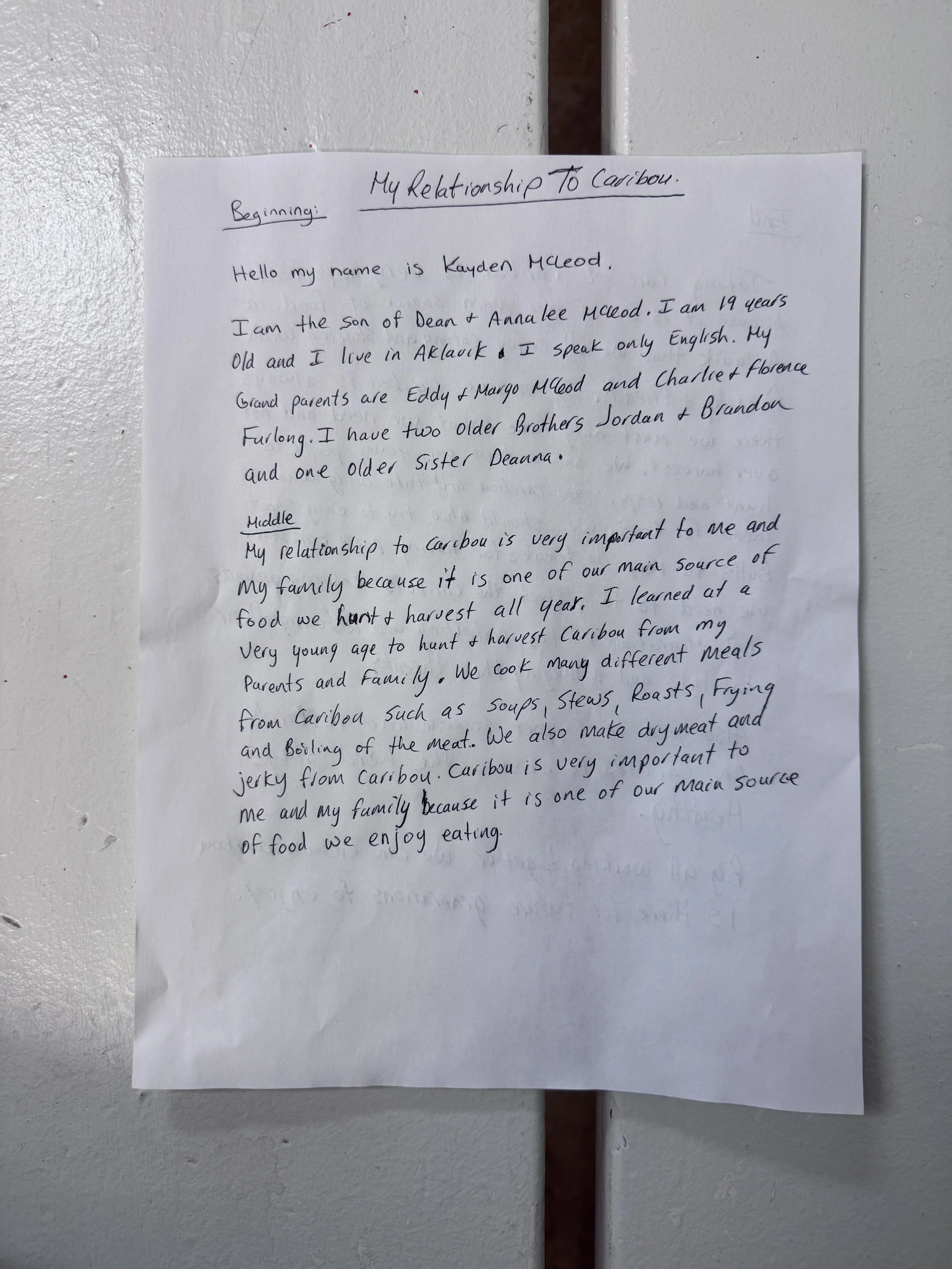
Kayden McLeod
Hello my name is Kayden Mcleod. I am the son of Dean + Annalee Mcleod. I am 19 years Old and I live in Aklavik .
I speak only English.
My Grand parents are Eddy & Margo Mcleod and Charlie & Forence Furlong. I have two older Brothers Jordan + Brandon and one older Sister Deanna.
My relationship to carbou is very important to me and My family because it is one of our main sources of food we hurt+ harvest all year.
I learned at a Very young age to hunt & harvest caribou from my Parents and Family. We cook many different meals With Caribou such as soups, Stews, Roasts, Frying and Boiling of the meat.
We also make dry meat and jerky from caribou.
Caribou is very important to me and my family because it is one of our main sources of food we enjoy eating.
Taking Care of Caribou is very important. To ensure caribou is always there we must only take what we need and not over harvest.
We should teach our young people to hunt and respect the caribou. We should also try to only shoot Bulls to keep the females for having more caribou.
We need to to protect the caribous calving grounds and Migration Routes, by protecting, restoring their habitats and managing their threats.
It is also good to support science and research on caribou populations to ensure the herd stays Healthy.
By all working together we can ensure caribou is there for future generations to enjoy.
Mason Arey
Hi My name is Mason Arey. My parents are Cody Kogiak and Shayla Arey. I often hunt when the caribou are near Aklavik. I hunt with my dad. He is the one that taught me how to hunt caribou properly. I remember my first caribou that I harvested. I was 8 years old. It was during winter when I shot that caribou, and we used skidoos.
Caribou is a part of our culture and our main source of diet. It’s a way of life. My parents teach me the importance of respecting the caribou and land.
The process of hunting has steps, from making sure I am prepared to shoot the caribou in the right spot to gutting it, loading it in the sled, bringing it home and then skinning it.
My dad makes sure that I have the proper equipment and knives to harvest the caribou.
My favourite part of hunting caribou is…. Shooting the caribou because it’s more fun than driving to look for it.
My favourite part of the caribou is eating the heart. It tastes really good fried.
These are a few reasons why caribou is important to me and my family.
Take what you need.
Corinne Dillon
HELLO MY NAME IS CORINNE DILLON
I AM A CREE/INUVIALUIT DECENDANT.
MY HOMETOWN IS TUKTOYAKTUK BUT HAVE BEEN LIVING IN AKLAVIK ROUGHLY FOR ABOUT 19 YEARS.
I WAS RAISED IN THẾ INUVALUKIUN TRADITION
İ GREW UP EATING THE HARVEST OF OUR LAND ESPECIALLY THE CARBOU WHICH IS THE MAIN STAPLE OF THE INUVIALUIT CULTURE.
IN TUKTOYAKTUK THE CARBON HERD THERE IS THE BLUENOSE HERD AND HERE IN AKLANK THE HERD IS CALLED THE PORCUPINE HERD
FOR MYSELF I DO FAVOUR THE CARIBOU TONGUE, RUMP FOR ROASTING AND DRY MEAT.
THE INUVIALUIT AND GWICH'IN COLLABORATE WITH THE MANAGEMENT AND RESPONSIBILITY FOR CARING FOR OUR ANIMALS
THE INDIGINOUS PEOPLE OF OUR LAND BEEN FOR CENTURIES TO THIS DATE TO PROTECT THE CARBOU’S HABITAT AS CLIMATE CHANGE, OVER-HUNTING, DISEASES, PROTECTING THE CARIBOUS MIGRATION ROUTES AND CALVING GROUNDS.
OUR FUTURE GENERATION WILL HAVE TO WORK AND LEARN FROM OUR ELDER'S AND RESPECT THE WAYS TO USEd PROTECT THE CARIBOU FOR OUR FUTURE GENERATION AND KEEP THE TRADITION WAYS ALIVE.
Patrick Gordon
Hi my name is Patrick Gordon, I’m from Aklavik.
My parents are Richard and Diane Gordon, my grandparents are the late Danny A and Annie b Gordon who is still with us today and the late Andrew and Martha Stewart
My languages our inuvialuit and GWICH’in
My relationship with caribou has always been important to me, since I was young.
My first experience with caribou started when I was 5 years old going hunting with my dad and grandfather, and uncle learning how to work with the caribou and travelling the mountains and coast
I always travelled with my dad, grandfather and uncle till I was old enough to do it on my own and teach my kids and younger hunters what I was taught.
Caribou are the main source of food for our people and we use everything from the caribou.
we want to protect the caribou and the calfing grounds for future generations to come.
It is really important to teach the young people about the caribou so they protect the caribou in the future.
It’s also important that when harvesting caribou our elders always told us to always share and respect the animal
I always try to teach the younger people what was taught to me from my grandparents and parents and other hunters I travelled with.
it is very important that we learn a lot about our caribou herd cause we found out that numbers dropped do to global warming and climate change
But the herd is still in a healthy population and that they are moving further west in Alaska and always staying in Alaska longer then we expected but through traditional knowledge, we know the caribou will always come back to Canada to there winter grounds and in the summer and fall season
It would be so nice to get the younger generation involved with caribou management and scientific studies for the future ahead because the caribou are taking different migration routes and climate change and global warming is having a big effect on the herd.
I always try to encourage the younger generation to always get involved with the porcupine management boards to learn more about the herd and how could we protect it for the future ahead
Thank you
Talina Storr
My name is Talina Storr, my Grandparents are Lorna and Billy storr from Aklavik Northwest Territories. We have lived here in the Delta for many generations and we speak Gwichin and Inuvialuit as our second language. Aklavik NT is a small remote community in the north also surrounded by other communities such as Inuvik, Tuktoyuktuk, Tsiigehchic and Ft McPherson. My late great grandparents Johnny and Jane Charlie were originally from the Yukon and moved to Fort McPherson in the 1940s. That’s where my Great Grandfather became the Chief and lead our people for many years and had started a family with 12 children and his wife Jane.
My great grandfather from my Grampas side was also originally from Whitby England but when world war came in the 1900’s he travelled to Coppermine which is kugluktuk now and married Kila. My grandparents Billy and Lorna Storr moved to Aklavik to start their life together in 1972 which is where I call home today.
My relationship with the Caribou and wildlife in our mountains are very strong it’s been in my diet for as long as I can remember. I remember the first time I saw Caribou as a kid I was travelling with my Nana and Grampa on the Dempster highway and seen the Herd crossing by the horseshoe. In that moment I was never happier to end up in a place where we have all the freedom we can have.
If I had a hundred more lives I’d choose this one in every single one of them. Not because it gave me everything but because it taught me what really matters. People often ask me, why do I choose to stay here? Why live somewhere so isolated when you can move to the city and have everything there. My answer was never clear, I never knew why I didn’t want to leave, it was until I visited the city’s more and more. It was always the people. The land. The culture and connection I have with who I am can never be replaced, it’s in my heart and this is where I belong.
Sure living in the city might be fun or where they find it best, but this. Money could never buy the true happiness of all the land and freedom. You’re connected to your roots and land. All year long each community holds events that have been happening for decades and decades. The main biggest events are the carnivals held each weekend in April, being in every community weekend after weekend. It brings each community together and hosts snowmobile races, foot races, tea boiling, and late night dances. Another big one is the Midway Lake Musical Festival, held every first weekend of August, my favourite one. They have bands who play from morning till night and dancers that will dance until the band gets too tired to keep playing. They have local singers and drummers who go up and sing and even sometimes, famous singers.
The Caribou and wildlife are severely important to our people and play a big role in our way of life, it’s where we feed, give and grow. It’s our livelihood to hunt off our land and has been for thousands of years. But in this modern day I find it very concerning to try and keep our heard’s safe and healthy with all the climate change, changing migrations as development increases more and more.
I think a majority of the world is stuck on “There’s too much of us one of us can’t make a difference” but i believe you definitely can big or small. It’s up to you if you want to see a difference. Be the change you wish to see. And never stop learning and passing your knowledge onto the next generation. They will protect it if you do.
If you are also concerned and want to keep our wildlife and heards safe and healthy from the POTUS’s gas and oil development that will impact the future habitats of calving grounds forever visit gwichin steering committee.com and sign the petition.
Paxton Gordon
Hi my name is Paxton Gordon and I am 15 years old
I started going trapping at a young age with my dad Patrick Gordon. and that’s where in learned how to trap.
Trapping is important to my because it was my grandfather Danny A trap line and I want to keep his trap line alive and teach my future children.
This season I caught 10 or 9 lynx’s 1 fox. And my most fun experience with trapping is when me and my dad caught 9 wolverines and 5 lynx that’s when my dad learned me how to skin a wolverines.
Vivian McDonald
Hello, my name is Vivian McDonald. I am an Inuvialuk/Gwich’in woman. I live in Aklavik,NT.
My parents are the late Allen Koe Sr and the late Debbie Illasiak. My grandparents are the late Patrick and Anna Illasiak and The late chief Jim and Vivian Koe.
I enjoy travelling on the land, I love to take pictures. I enjoy sewing and beading.
My relationship with caribou is important because the meat is healthy, nutritious and lean.
We use the caribou skins for creating traditional arts and crafts.
My dad was an avid caribou hunter most of his life.
He was taught by his dad The late Chief Jim Koe.
He taught his sons to hunt caribou, and to live off the land.
My husband also hunts caribou, his dad, grandfather and uncles taught him how to hunt.
For thousands of years the Gwich’in nation has relied on caribou for sustenance. Caribou also hold a spiritual significance for many indigenous nations, including the Gwich’in nation.
We can pass down our traditions to the younger generations so we don’t lose our way of life. We can ensure caribou populations are healthy for future generations by letting the leaders pass and by only taking what we need. The strong ones are leading the pack.
We need to protect the caribou calving grounds from drilling and pipelines, by spreading awareness, writing letters and sharing our connection to the caribou with the world.
We need to take care of our caribou, so they aren’t scared away.